

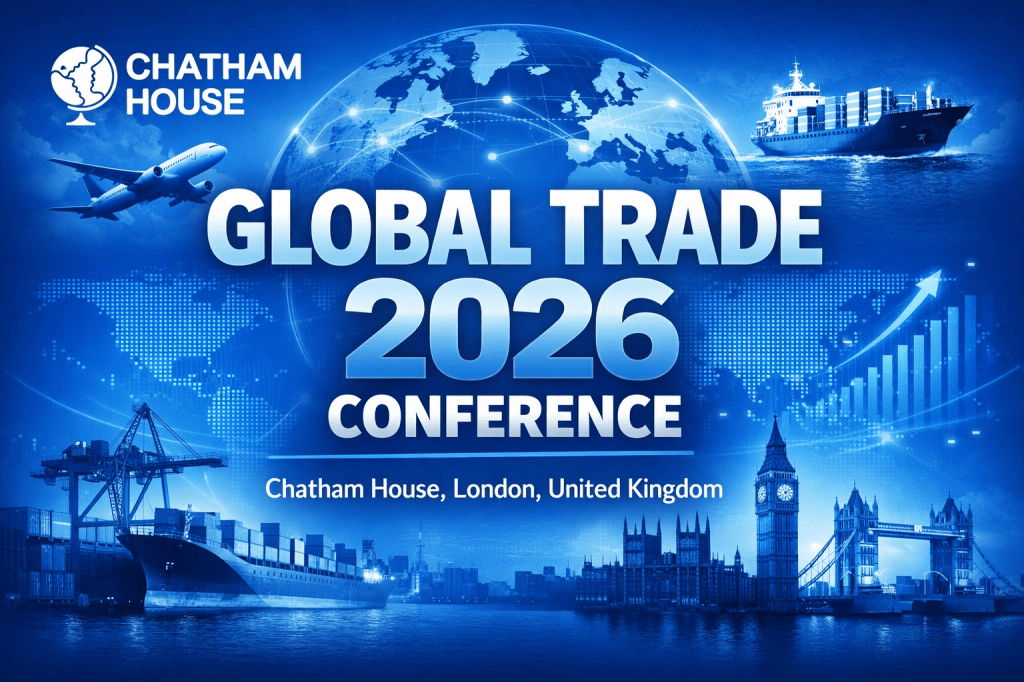
Global leaders, policymakers, economists, financiers and corporate executives gathered in the stately headquarters of Chatham House in London, United Kingdom on 19th March 2026 for one of the most consequential economic forums of the year: Global Trade 2026. The conference unfolded at a moment of profound uncertainty. After decades of expanding globalization, the world economy is entering what many speakers described as a “post-efficiency era” which is defined less by cost optimization and more by resilience, security and geopolitical alignment.
Founded in 1920, Chatham House has long been one of the world’s most influential policy think tanks, providing a neutral platform for high-level debate on international affairs. Its hallmark innovation, the Chatham House Rule allows participants to speak freely without attribution, encouraging candid exchanges on sensitive geopolitical and economic issues. That confidentiality proved critical in 2026, as trade tensions, industrial policy rivalries and strategic decoupling dominated discussions.
Against a backdrop of rising geopolitical tensions, slowing trade growth and intensifying economic nationalism, the summit brought together policymakers, corporate executives, financiers and scholars to confront a central question of our time: What comes next for global trade? The answer, as it unfolded across keynote sessions, closed-door dialogues and high-level panels, was neither simple nor comforting. The global trading system is not collapsing, participants agreed, but it is undergoing a profound and irreversible transformation that will reshape markets, redraw alliances and redefine the rules of economic engagement for decades to come.
For more than three decades, globalization was guided by a relatively stable framework: liberalized markets, integrated supply chains and a belief in the efficiency of open trade. That framework is now under strain. At Global Trade 2026, speaker after speaker pointed to the same structural shift: the transition from efficiency-driven globalization to security-driven economic policy. Governments are no longer willing to rely solely on global markets for critical goods and technologies. Instead, they are intervening more aggressively through subsidies, export controls and investment screening to protect national interests. This shift marks what some participants described as the “end of naive globalization”. In its place is a more pragmatic, and often more fragmented, system.
One of the defining features of the event was its adherence to the Chatham House Rule, which allows participants to use information shared during discussions without revealing the identity of speakers. This framework enabled unusually frank exchanges on sensitive topics such as trade disputes, sanctions and strategic decoupling. Executives from multinational corporations spoke openly about the challenges of operating in an increasingly politicized environment. Government officials acknowledged the tensions between domestic political pressures and international commitments. Economists debated whether the current trajectory represents a temporary disruption or a long-term realignment. The result was a rare level of candor that underscored both the urgency and the complexity of the issues at hand.
Perhaps the most dominant theme of the summit was “Fragmentation”. Global trade is no longer a single, unified system. Instead, it is evolving into a patchwork of overlapping networks shaped by geopolitical alliances, regulatory regimes and strategic interests. As the implications are profound, businesses must now navigate the three dynamics of global market that emerged ⬇️
• Regionalization: Trade flows are increasingly concentrated within regional blocs. North America, Europe and Asia-Pacific are becoming more internally integrated, while cross-bloc trade faces growing friction.
• Friend-Shoring: Countries are prioritizing trade relationships with political allies, reducing dependence on strategic rivals. This trend is reshaping supply chains and investment patterns.
• Parallel Systems: In some sectors, particularly technology, parallel ecosystems are emerging, with different standards, platforms and regulatory frameworks.
Few areas illustrate the transformation of global trade more clearly than supply chains. For decades, companies optimized for cost efficiency, building complex networks that spanned continents. That model is now being re-evaluated.
At the summit, executives described a shift toward resilience and redundancy. Companies are diversifying suppliers, relocating production closer to key markets and investing in inventory buffers. While these changes increase costs, they reduce exposure to disruptions caused by whether geopolitical tensions, pandemics or climate events. One panelist summarized the new reality succinctly: “Supply chains are no longer just about logistics, they are about strategy”.
Another defining feature of the current era is the resurgence of industrial policy. Governments around the world are actively shaping economic outcomes through targeted interventions. These include subsidies for strategic industries, incentives for domestic manufacturing and restrictions on foreign investment in sensitive sectors.
At Global Trade 2026, participants debated the implications of this trend. Supporters argued that industrial policy is necessary to ensure national security and economic resilience. Critics warned that it risks distorting markets, triggering retaliatory measures and undermining the global trading system. What is clear is that industrial policy is no longer the exception, it is becoming the norm.
Digital trade was once seen as the great equalizer; a borderless domain where goods and services could flow freely across countries. That vision is now being challenged. At the summit, discussions highlighted the growing complexity of digital trade, driven by: data localization requirements, diverging privacy regulations, cybersecurity concerns, and digital taxation policies. These factors are creating new barriers, even as digital commerce continues to expand. The result is a paradox: the most dynamic segment of global trade is also one of the most fragmented.
Foreign Direct Investment (FDI) is also undergoing a transformation. In the past, investment decisions were driven primarily by market considerations, cost, demand and efficiency. Today, they are increasingly influenced by political factors. Governments are scrutinizing foreign investments more closely, particularly in sectors such as technology, infrastructure and energy. At the same time, they are offering incentives to attract investment in strategic industries. This dual approach of encouraging some investments while restricting others is reshaping global capital flows. For businesses, it adds a new layer of complexity to decision-making.
For Europe, the changes in global trade present a unique challenge. As one of the world’s most open and integrated economic regions, Europe has benefited significantly from globalization. However, it is also highly exposed to external shocks and geopolitical tensions. At Global Trade 2026, participants examined how Europe can balance its commitment to open markets with the need for greater resilience. Issues such as energy security, technological sovereignty and supply chain diversification were central to the discussion. The outcome will have far-reaching implications not just for Europe, but for the global trading system as a whole.
No discussion of global trade would be complete without addressing the state of the multilateral system. Institutions such as the World Trade Organization have long provided the framework for international trade. However, their effectiveness is increasingly being questioned. At the summit, participants pointed to several challenges: weak enforcement mechanisms, growing use of unilateral trade measures, and diverging national priorities. While few expect the multilateral system to disappear entirely, many believe it will play a reduced role in the future. Instead, regional and bilateral agreements are likely to become more prominent.
For emerging economies, the transformation of global trade presents both risks and opportunities. On the one hand, fragmentation could limit access to key markets and increase volatility. On the other hand, it creates new openings for countries that can position themselves strategically within evolving supply chains. Participants highlighted the importance of regional integration initiatives, such as the African Continental Free Trade Area, in strengthening the resilience of emerging markets. For countries like Nigeria, the message was clear: adaptability and strategic positioning will be critical.
The intersection of trade, technology and natural resources is becoming a central battleground in the global economy. At Global Trade 2026, discussions focused on sectors such as: semiconductors, critical minerals, and renewable energy technologies. Control over these sectors is increasingly seen as a source of strategic advantage. As a result, trade policy is being used to secure access to resources and protect technological leadership. This convergence of economic and strategic considerations is reshaping the nature of global competition.
For businesses, the implications of these changes are profound. The era of predictable globalization is over. In its place is a more complex and uncertain environment, where geopolitical risks play a central role. At the summit, executives outlined several key strategies: diversifying supply chains, investing in resilience, enhancing risk management capabilities, and engaging more closely with policymakers. The ability to navigate this new landscape will be a key determinant of corporate success.
Amid the focus on geopolitics and economics, the summit also addressed the social implications of changing trade patterns. Participants expressed concern about: rising inequality between countries, uneven distribution of trade benefits, and the impact of economic transitions on workers. Ensuring that the benefits of trade are more widely shared will be critical to maintaining public support for open markets. Several overarching insights emerged from the discussions ⬇️
(1) Globalization Is Evolving, Not Ending: Trade will continue to play a central role in the global economy, but under new rules and structures.
(2) Geopolitics Is Now Central: Economic decisions are increasingly shaped by political and strategic considerations.
(3) Resilience Is the New Priority: Both governments and businesses are focusing on stability and security.
(4) Fragmentation Is Here to Stay: The global trading system is becoming more complex and less unified.
(5) Adaptation Is Essential: Success in the new environment will depend on the ability to adapt quickly.
As Global Trade 2026 concluded, one thing was clear: the world is entering a new phase of economic history. The rules that governed global trade for decades are being rewritten. New alliances are forming. Old assumptions are being challenged. The outcome of this transformation is uncertain. It could lead to a more resilient and diversified global economy or to greater fragmentation and instability. What is certain is that the stakes are high. The decisions made by governments, businesses and institutions in the coming years will shape the future of global trade, and by extension, the global economy.
The Global Trade 2026 Conference at Chatham House, London offered a rare and candid glimpse into the forces reshaping the world economy. It revealed a system in transition that is moving away from the simplicity of open globalization towards a more complex and contested landscape. For policymakers, the challenge is to balance national interests with global cooperation. For businesses, it is to navigate uncertainty while seizing new opportunities. For societies, it is to ensure that the benefits of trade are shared more broadly. The future of global trade will not be defined by a single trend or event, it will be shaped by a multitude of forces economically, politically and technologically interacting in unpredictable ways. As the era of passive globalization is ending, the era of strategic global trade begins.
 MAGNIFICENZA