
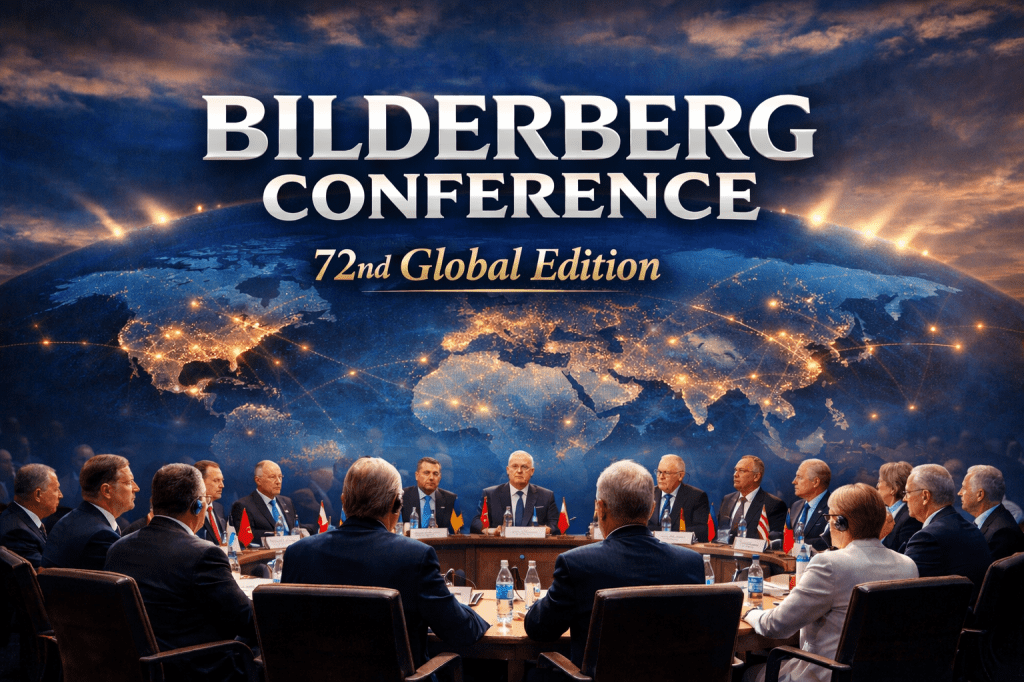
The annual Bilderberg Conference convened from 9th—12th April 2026 at the Salamander Hotel in Washington, D.C., USA, drawing an exclusive assembly of global political leaders, business executives, and academics from around the world. The closed-door summit focused on pressing global issues, including geopolitical stability, energy transitions, artificial intelligence governance, and international trade frameworks.
Few gatherings in the modern geopolitical landscape inspire as much intrigue, suspicion, and fascination as the Bilderberg Conference. Since its inception in 1954, the conference has operated as a discreet yet highly influential forum where political leaders, corporate executives, intellectuals, and media figures convene to discuss global issues. The 72nd Global Edition Of The Bilderberg Conference, held in an era marked by geopolitical volatility, technological acceleration, and ideological fragmentation, offers a compelling lens through which to examine the evolving nature of elite consensus-building in the 21st century.
The Bilderberg Conference derives its name from the Hotel De Bilderberg in Oosterbeek, Netherlands, where the first meeting took place. Conceived in the aftermath of World War II, the conference emerged from a desire to strengthen transatlantic cooperation between Western Europe and North America. The founders believed that informal dialogue among influential figures could help prevent ideological fragmentation and foster unity against the backdrop of Cold War tensions. From the outset, the conference was designed as a private forum. Participants were invited in a personal capacity rather than as official representatives of their governments or institutions. This distinction allowed for candid discussions unencumbered by diplomatic formalities or public accountability. Over time, the Bilderberg Conference evolved into a yearly gathering of approximately 120–150 individuals drawn from politics, finance, academia, and industry.
The core principle guiding the conference is the Chatham House Rule, which permits participants to use the information received during discussions but prohibits the identification of speakers or attribution of specific statements. This rule has been both a defining feature and a source of controversy.
The composition of Bilderberg participants is carefully curated to reflect a balance of sectors and perspectives, albeit within a relatively narrow elite spectrum. Attendees typically include heads of state, central bankers, CEOs of multinational corporations, leading academics, and influential media figures. The Steering Committee, which organizes the conference, determines the invitation list based on current global priorities and the perceived influence of potential participants.
The Bilderberg Conference: 72nd Global Edition continued this tradition, assembling a cohort that reflects the shifting centers of power in a multipolar world. Notably, there has been a gradual diversification in recent years, with increased representation from emerging economies, technology sectors, and younger leaders. However, critics argue that the conference remains fundamentally exclusive, reinforcing existing power structures rather than challenging them.
The selection process itself is opaque, raising questions about accountability and inclusivity. While organizers emphasize the importance of expertise and influence, detractors contend that such criteria inherently privilege established elites and marginalize alternative voices.
The 72nd Global Edition Of The Bilderberg Conference took place against a backdrop of profound global uncertainty. Several key themes dominated the agenda, reflecting the most pressing challenges of the contemporary era.
(1) Geopolitical Realignment: The shifting balance of power among major global actors was a central topic of discussion. The rise of new economic powers, the reconfiguration of alliances, and ongoing regional conflicts have created a complex and fluid geopolitical landscape. Participants examined the implications of these changes for global stability, trade, and security.
(2) Artificial Intelligence & Technological Governance: As artificial intelligence continues to reshape industries and societies, the need for effective governance frameworks has become increasingly urgent. Discussions focused on ethical considerations, regulatory approaches, and the potential for technological disruption to exacerbate inequality.
(3) Economic Fragmentation & Resilience: The global economy is experiencing a period of fragmentation characterized by supply chain disruptions, trade tensions, and divergent monetary policies. The conference explored strategies for enhancing economic resilience while maintaining interconnectedness.
(4) Climate Change & Energy Transition: Environmental sustainability remains a critical concern. Participants addressed the challenges of transitioning to renewable energy sources, balancing economic growth with environmental responsibility, and coordinating international climate policies.
(5) Information Integrity & Media Influence: In an age of digital misinformation and declining trust in institutions, the role of media and information ecosystems was a key focus. Discussions highlighted the need to safeguard democratic processes while preserving freedom of expression.
One of the most contentious aspects of the Bilderberg Conference is its commitment to privacy. Proponents argue that confidentiality is essential for fostering open and honest dialogue. Without the pressure of public scrutiny, participants can engage in frank discussions, explore unconventional ideas, and build trust across sectors and national boundaries.
Critics, however, view this secrecy as inherently problematic. In a democratic society, decisions that shape public policy should be subject to transparency and accountability. The perception that a small group of elites is influencing global affairs behind closed doors fuels conspiracy theories and undermines public trust.
The Bilderberg Conference: 72nd Global Edition highlighted this tension. While organizers made efforts to increase transparency by publishing participant lists and general topics, the substance of discussions remained inaccessible. This partial openness reflects a broader challenge: how to balance the benefits of confidentiality with the demands of an increasingly informed and skeptical public.
The actual influence of the Bilderberg Conference is a subject of ongoing debate. Some observers attribute significant policy outcomes and strategic alignments to discussions held at these meetings. Others argue that the conference serves primarily as a networking platform rather than a decision-making body.
It is important to distinguish between direct and indirect influence. The conference does not produce official statements or binding resolutions. However, it facilitates the exchange of ideas among individuals who wield considerable power in their respective domains. These interactions can shape perspectives, inform decision-making, and foster informal consensus. The Bilderberg Conference: 72nd Global Edition exemplified this dynamic. While no concrete policies emerged, the convergence of influential actors around shared concerns such as technological governance and geopolitical stability suggests a subtle but meaningful form of coordination.
The Bilderberg Conference has long been a magnet for criticism. Concerns about elitism, lack of transparency, and potential conflicts of interest are frequently raised. In recent years, these critiques have been amplified by the rise of social media and alternative information channels.
One common criticism is that the conference perpetuates a form of “elite consensus” that may not reflect the interests or perspectives of broader populations. By bringing together individuals from similar socio-economic backgrounds, the conference risks reinforcing existing biases and limiting the diversity of ideas.
Another concern is the potential for undue influence. When political leaders and corporate executives meet in private settings, questions arise about the boundaries between public service and private interest. Although there is no concrete evidence of wrongdoing, the perception of impropriety can be damaging in itself.
The Bilderberg Conference: 72nd Global Edition faced heightened scrutiny in this regard. Activists and journalists called for greater transparency and accountability, arguing that the stakes of global decision-making are too high to be confined to closed-door discussions.
The rise of digital technology has transformed the information landscape, making secrecy increasingly difficult to maintain. Leaks, investigative journalism, and real-time reporting have eroded the barriers that once shielded elite gatherings from public view. In this context, the Bilderberg Conference faces a strategic dilemma. Maintaining strict confidentiality risks alienating a public that demands openness. Conversely, increasing transparency could undermine the very conditions that enable candid dialogue.
The conference reflected an attempt to navigate this tension. While the conference retained its core principles, organizers adopted a more proactive communication strategy, providing limited insights into the agenda and objectives. Whether this approach will be sufficient to address public concerns remains an open question.
The continued relevance of the Bilderberg Conference can be understood in terms of its function as an elite network. In a world characterized by fragmentation and uncertainty, such networks provide a platform for coordination and mutual understanding among key actors. The conference underscored the importance of these connections. As traditional institutions struggle to keep pace with rapid change, informal forums like Bilderberg offer a flexible and adaptive space for dialogue. However, this flexibility comes at the cost of transparency and inclusivity. The challenge moving forward is to reconcile these competing priorities. Can elite networks evolve to become more inclusive and accountable without sacrificing their effectiveness? The answer to this question will shape the future of global governance.
The Bilderberg Conference occupies a paradoxical position in the global order. It is both influential and elusive, central and peripheral, trusted by insiders and distrusted by outsiders. The Bilderberg Conference: 72nd Global Edition exemplifies these contradictions, highlighting the enduring relevance of elite dialogue while exposing the tensions inherent in its operation. Ultimately, the significance of the Bilderberg Conference lies not in any single meeting or decision, but in its role as a microcosm of global power dynamics. It reflects the complexities of a world where influence is diffused, authority is contested, and the boundaries between public and private are increasingly blurred.
As the world continues to grapple with unprecedented challenges, the need for dialogue among influential actors is undeniable. However, the legitimacy of such dialogue depends on its alignment with broader societal values, including transparency, accountability, and inclusivity. The future of the Bilderberg Conference and similar forums will depend on their ability to adapt to these evolving expectations. The Bilderberg Conference: 72nd Global Edition marks a step in this ongoing process, offering both a reflection of the present and a glimpse into the future of global governance. In the end, the question is not whether elite gatherings should exist, but how they can operate in a way that balances effectiveness with legitimacy. The answer to this question will shape not only the trajectory of the Bilderberg Conference, but the broader architecture of power in the 21st century.
 MAGNIFICENZA