
The 13th annual edition of the Africa CEO Forum, held on the 14th–15th May 2026 in Rwanda’s capital, arrives at a pivotal moment for the African continent. In the Kigali’s presidential board rooms and conference halls, Africa’s corporate elite gathered with an unusually urgent mission on how to establish phenomenal enterprises to compete in a fractured global economy increasingly dominated by geopolitical blocs, supply-chain nationalism, and technological concentration.
The annual summit of the Africa CEO Forum is the largest international meeting of the African private sector. Two days of conferences, debates and high-level meetings dedicated to highlighting the driving role of the private sector in the development of the African continent.
Organisers describe the summit as Africa’s largest annual private-sector convention, bringing together more than 2500 to 2800 executives, investors, policymakers, development finance institutions and African political leaders. But unlike previous editions, this year’s conversations are less about Africa’s potential and more about Africa’s leverage. Under the theme, “The Scale Imperative: Why Africa Must Embrace Shared Ownership”, the forum has become a strategic referendum on whether African firms can evolve from fragmented national champions into continent-wide industrial, financial and technological powerhouses.
The underlying anxiety is clear; in a world reorganising around scale, Africa risks being left with markets that are too small, capital pools that are too shallow, and enterprises too fragmented to compete globally.
The forum held at the Kigali Convention Centre, a venue that has increasingly become synonymous with Africa’s investment diplomacy. The decision to host the summit in Kigali is itself symbolic. Over the past decade, Rwanda has positioned itself as one of Africa’s premier destinations for diplomacy, investment forums and technology conferences. By hosting the forum, Kigali strengthens its growing reputation as a convening hub for Africa’s public-private dialogue.
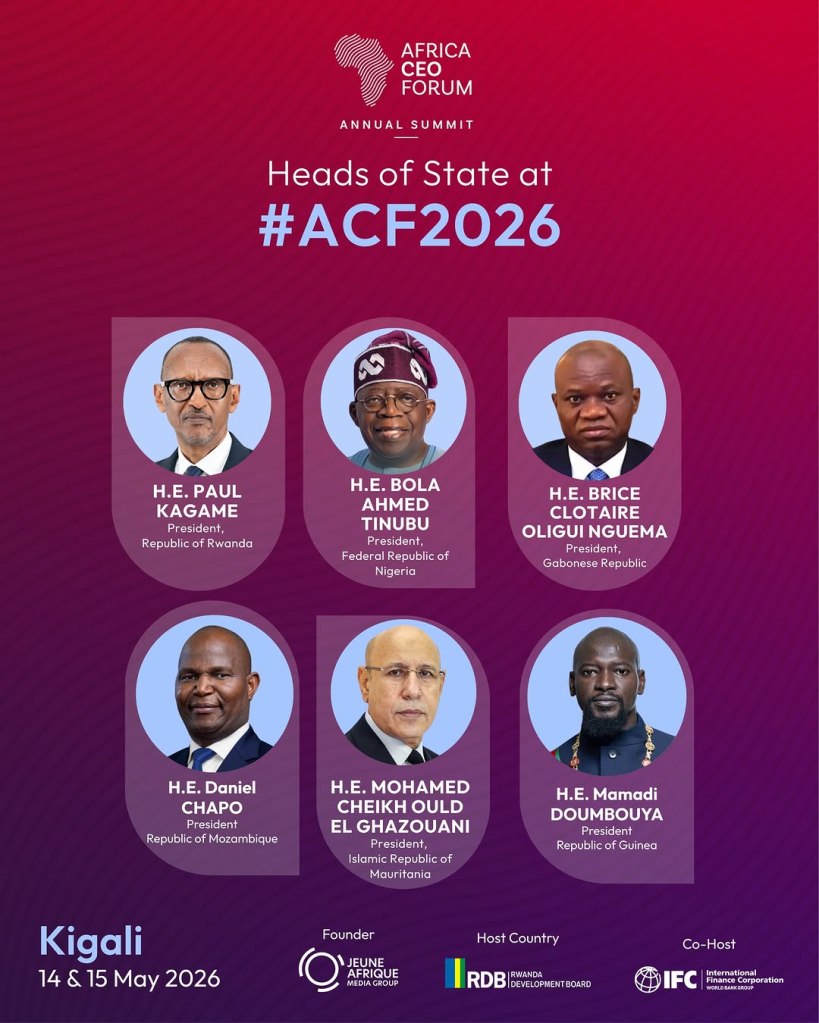
Among the prominent speakers and attendees are Paul Kagame (President Of Rwanda), Asiwaju Bola Ahmed Tinubu (President Of Nigeria), Mohamed Ould Cheikh El Ghazouani (President Of Mauritania), Daniel Chapo (President Of Mozambique), Brice Clotaire Oligui Nguema (President Of Gabon), Mamadi Doumbouya (President Of Guinea), William Ruto (President Of Kenya), Robert Beugré Mambé (Prime Minister Of Côte d’Ivoire), Bah Oury (Prime Minister Of Guinea), Mwigulu Nchemba (Representative Of Tanzania), Makhtar Diop (Representative Of Senegal), international business executives and government officials from across the African continent.
The presence of the International Finance Corporation (IFC) as a strategic partner further underscores how development finance institutions are recalibrating their Africa strategy around private-sector-led growth. For Rwanda, the forum is also an exercise in economic branding. The country has aggressively marketed itself as a stable, reform-oriented economy capable of hosting major international gatherings despite heightened geopolitical tensions and regional uncertainty.
The phrase defining this year’s summit is “Scale or Fail”. The forum’s organisers argue that African companies can no longer survive as isolated national businesses serving narrow domestic markets. Instead, companies must pool capital, expand regionally, merge strategically, and develop cross-border ownership structures capable of producing continental champions. That message reflects a hard economic reality. Africa remains home to 54 countries, many with relatively small economies and fragmented regulatory systems. The continent’s combined population now exceeds 1.57 billion people, making it one of the world’s largest consumer markets by demographic scale. Yet intra-African trade remains structurally weak compared with Europe or Asia.
The business executives that attended the forum increasingly believe that the next phase of African growth cannot rely solely on commodity exports or foreign direct investment from global powers. Instead, growth must come from African-controlled capital, African institutional investors, and African-led industrial ecosystems. The concept of “shared ownership” heavily promoted throughout the summit is designed to encourage co-investment models between African states, pension funds, sovereign wealth funds, family offices and private corporations. The strategic logic is straightforward; Africa cannot industrialise at scale if its largest infrastructure, telecom, logistics and energy projects remain overwhelmingly financed and controlled externally.
One of the most striking themes emerging from the forum is the rise of what analysts increasingly describe as African corporate nationalism. This is not nationalism in the political sense, but rather an economic doctrine focused on building resilient African-owned enterprises capable of competing with multinational giants from the United States, Europe, China and the Gulf.
The forum is confronting a transformed global landscape. The era of hyper-globalisation has weakened. Governments worldwide are prioritising supply-chain resilience, strategic autonomy and industrial policy. The scramble for critical minerals, AI infrastructure, clean energy systems and digital sovereignty is reshaping investment flows. African leaders believe this disruption could create an opening for the continent but only if African companies become large enough to capture value. The conversations in Kigali reflect a broader continental shift away from dependency models toward partnership models. African governments increasingly want investors who will build manufacturing capacity, create local value chains and share risk with domestic institutions. This aligns with wider geopolitical developments.
Earlier in the month ahead the forum, at the Africa-France Summit in Kenya, French President Emmanuel Macron announced €23 billion in joint investments involving French and African companies, with a strong emphasis on strategic autonomy, technology and clean energy cooperation. The language mirrors many of the themes dominating the Africa CEO Forum: strategic autonomy, co-investment and African industrial participation.
Hovering over virtually every panel discussion is the unfinished promise of the African Continental Free Trade Area. The AfCFTA was designed to create the world’s largest free-trade area by number of participating countries. Yet implementation gaps remain significant. The business executives at the forum argue that regulatory fragmentation, customs delays, weak logistics infrastructure and inconsistent trade enforcement continue to undermine continental integration. The forum’s “Invest In” sessions which allow CEOs and investors to engage directly with governments are increasingly important because they provide rare opportunities to discuss practical barriers to scaling across borders.
Many business leaders privately admit that Africa’s integration challenge is not conceptual; it is operational. Cross-border payments remain costly. Transport corridors remain underdeveloped. Currency volatility remains severe. Access to long-term financing remains limited. As a result, many African firms remain trapped in national markets that are too small to support globally competitive scale. The urgency around integration has intensified because global capital is becoming more selective. Investors are increasingly seeking markets with scale, policy predictability and integrated value chains. African business executives fear that without meaningful continental integration, Africa could become merely a supplier of raw materials for global green-transition industries rather than a manufacturing and technology hub in its own right.
Perhaps more than any previous edition, the 2026 forum places finance at the centre of Africa’s growth debate. Executives are grappling with a difficult macroeconomic environment marked by high interest rates, currency pressures, debt stress and declining risk appetite among international lenders. This has elevated the importance of domestic capital mobilisation. African pension funds, insurance firms and sovereign investment vehicles collectively control hundreds of billions of dollars in assets. Yet only a limited portion is deployed into productive African infrastructure, manufacturing or industrial expansion. The summit’s emphasis on shared ownership is partly an attempt to unlock these pools of capital. The argument advanced by several participants is that African institutional investors must become more aggressive in financing African growth sectors rather than concentrating primarily on government debt or offshore assets.
Development finance institutions are also repositioning themselves. The International Finance Corporation (IFC) has increasingly framed its Africa strategy around enabling larger private-sector ecosystems capable of generating jobs at scale. This reflects a wider recognition that demographic growth alone will not produce prosperity. Africa’s population is the youngest in the world, and its labour force is expanding rapidly. But without industrial expansion and large-scale enterprise growth, the continent risks facing deepening unemployment and inequality pressures.
Technology and artificial intelligence are also central to this year’s agenda. Executives across banking, telecoms, agriculture, logistics and healthcare increasingly view AI not as a future possibility but as an immediate competitive necessity. Africa’s digital economy has expanded rapidly over the past decade, driven by mobile connectivity, fintech innovation and digital payments. Yet concerns are growing that Africa could again become dependent on imported technologies rather than building indigenous innovation ecosystems. Panels at the forum are expected to focus heavily on digital public infrastructure, AI adoption, fintech expansion and data governance. There is particular interest in how African firms can avoid becoming passive consumers of AI systems designed elsewhere. Several executives argue that Africa’s next generation of competitiveness will depend on ownership of digital infrastructure, cloud ecosystems, data frameworks and regional payment systems. The challenge is formidable. Africa still faces major infrastructure deficits in broadband access, data centres, power supply and advanced computing capacity. Yet many participants believe the continent could leapfrog traditional industrial development models through strategic investment in digital systems.
Beyond technology, the forum’s discussions repeatedly return to three sectors viewed as foundational for African competitiveness: energy, logistics and industrial manufacturing. Executives argue that Africa’s industrial ambitions will remain constrained without reliable power systems and modern transport networks. The continent possesses enormous reserves of critical minerals essential for the global energy transition, including cobalt, lithium, manganese and rare earth elements. Yet African leaders increasingly want more local processing and industrial value addition rather than simple extraction. This issue has become politically charged across multiple African economies. Governments are demanding greater domestic participation in mining value chains, battery manufacturing and energy infrastructure projects. At the same time, logistics remains one of Africa’s biggest structural weaknesses. Shipping costs across African markets can exceed costs between Africa and Europe. Border delays and fragmented transport systems continue to undermine competitiveness. Executives at the forum increasingly view logistics integration as inseparable from industrialisation. Without efficient transport corridors and regional supply chains, African manufacturers struggle to compete against imports from Asia, Europe or the Middle East.
Another defining characteristic of this year’s forum is the rehabilitation of industrial policy. For years, many African economies operated under market-liberalisation frameworks that reduced direct state involvement in industrial development. Today, however, governments and corporate leaders are openly discussing strategic intervention. This includes targeted support for manufacturing sectors, local-content policies, infrastructure financing, export incentives and technology partnerships. The mood in Kigali reflects a growing global consensus that markets alone may not produce industrial transformation. The United States, European Union, China and Gulf economies are all aggressively deploying industrial strategies tied to energy security, semiconductors, AI and manufacturing resilience. African policymakers increasingly believe the continent must do the same. Yet the challenge lies in execution. African governments often face fiscal constraints, institutional weaknesses and governance concerns that complicate long-term industrial planning. That is why the public-private partnerships discussed at the forum are so critical. Executives argue that neither governments nor private firms can achieve continental transformation independently. The emphasis is increasingly on coordinated risk-sharing frameworks. The forum is also unfolding against intensifying global competition for influence in Africa.
China remains deeply embedded across African infrastructure and commodity sectors. Gulf investors are expanding aggressively into ports, agriculture, renewable energy and logistics. Western governments are recalibrating their Africa strategies amid growing concern about geopolitical competition. African leaders increasingly believe this rivalry creates leverage opportunities. Rather than aligning exclusively with any single bloc, many governments are pursuing multi-alignment strategies designed to maximise investment flows while preserving strategic autonomy. This explains why terms like “partnership”, “shared ownership”, and “co-investment” dominate discussions in Kigali. African executives no longer want relationships defined solely by aid or extraction. They want participation in ownership structures, technology transfer and industrial ecosystems. The private sector’s role in this geopolitical balancing act is expanding rapidly. Large African conglomerates are becoming strategic actors in infrastructure, digital systems, manufacturing and regional trade integration.
One of the clearest messages from the Africa CEO Forum is that CEOs themselves are becoming geopolitical actors. In many African markets, large corporations now influence infrastructure deployment, digital connectivity, financial inclusion and regional integration as much as governments do. Telecom firms shape digital access. Banks influence capital flows. Logistics companies shape trade integration. Energy companies shape industrial expansion. This growing corporate influence has elevated the importance of executive leadership across the continent. The forum’s structure reflects this reality by placing heads of state and CEOs in the same strategic conversations. Increasingly, African economic transformation depends not only on public policy but also on whether corporate leaders are willing to pursue long-term regional expansion strategies rather than short-term national market dominance.
For Rwanda, the forum reinforces a broader national strategy centred on positioning the country as a gateway for continental business engagement. Despite its relatively small domestic market, Rwanda has built a reputation for administrative efficiency, digital governance and investment facilitation. The country’s ability to host major gatherings has become part of its economic diplomacy toolkit. By attracting the continent’s most influential executives and investors, Rwanda strengthens its profile as a neutral convening platform for African business dialogue. In an increasingly competitive African investment landscape, visibility and reputation play growing roles in attracting capital, partnerships and multinational operations. Yet beneath the forum’s ambitious rhetoric lies a more uncomfortable reality. Africa still faces deep structural vulnerabilities. Debt pressures remain severe in multiple economies. Currency depreciation continues to disrupt business planning. Political instability persists in several regions. Infrastructure deficits remain enormous. The continent also faces mounting climate risks, food insecurity concerns and demographic pressures.
Moreover, while executives frequently discuss continental integration, practical implementation remains uneven. Many African governments continue to prioritise national interests over regional harmonisation. Protectionist tendencies remain widespread. There is also the unresolved issue of trust. Cross-border mergers, joint ventures and shared ownership structures require high levels of regulatory certainty and institutional confidence; conditions that do not yet exist uniformly across the continent. Still, executives gathering in Kigali appear increasingly convinced that fragmentation is no longer sustainable. The world economy is consolidating around scale, strategic blocs and industrial ecosystems. Africa’s leaders fear that without rapid corporate scaling and deeper regional integration, the continent risks marginalisation in the next phase of global growth.
The ultimate test for the Africa CEO Forum will not be the quality of speeches delivered in Kigali but the durability of partnerships formed afterward. Forums of this nature often generate ambitious declarations that fade once delegates return home. Yet there are signs this year’s gathering carries unusual urgency. African executives are operating in a world where capital is harder to secure, technology competition is intensifying, and geopolitical fragmentation is reshaping trade and investment patterns. Under those conditions, the forum’s core message that Africa must build larger, more integrated, African-controlled enterprises resonates more strongly than ever. Whether that ambition can be realised remains uncertain. But one thing is increasingly clear that Africa’s private sector no longer sees itself merely as a participant in global economic change. The 13th annual edition of the Africa CEO Forum in Kigali has showcased that the African continent’s corporate leadership is redefining the future of global economy.
 MAGNIFICENZA