
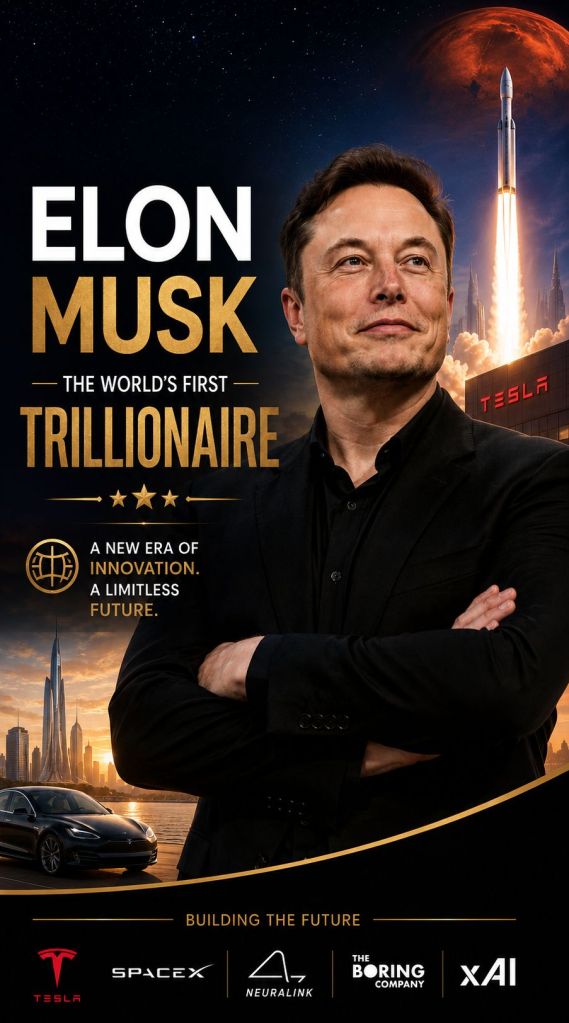
In June 2026, economic history crossed a threshold that once seemed confined to science fiction. Elon Musk officially became the first individual to surpass a verified net worth of $1 trillion, a milestone achieved following the landmark Nasdaq debut of SpaceX. Estimates placed Musk’s fortune at approximately $1.1 trillion, with the overwhelming majority stemming from his ownership stake in SpaceX, complemented by substantial holdings in Tesla and smaller positions in ventures such as Neuralink and The Boring Company. The achievement represented far more than a numerical milestone; it symbolized the culmination of one of the most extraordinary demonstrations of financial excellence in modern history.
The rise of Musk to trillionaire status is often misunderstood as a story of technological innovation alone. While innovation undoubtedly played a central role, the deeper story is one of financial mastery. Musk’s ascent illustrates how strategic capital allocation, concentrated ownership, asymmetric risk-taking, long-term vision, and the relentless pursuit of scalable value creation can generate wealth on an unprecedented scale. His journey provides a powerful case study in how extraordinary financial outcomes emerge when entrepreneurial vision is combined with disciplined execution and unwavering commitment.
Financial excellence is not simply the accumulation of money. Many wealthy individuals inherit fortunes, benefit from monopolistic advantages, or experience favorable market conditions. Financial excellence, by contrast, involves the ability to create, preserve, multiply, and strategically deploy capital over long periods while continuously generating value for stakeholders.
Musk’s trillion-dollar achievement stands apart because nearly all of his wealth was self-created through company building. Unlike many historical billionaires who inherited substantial fortunes, Musk began with modest circumstances and repeatedly reinvested the proceeds of one success into increasingly ambitious ventures. Rather than seeking security, he consistently embraced uncertainty. Rather than diversifying widely, he concentrated his resources in a few transformative opportunities. Rather than optimizing for short-term gains, he pursued long-term value creation.
The result was a wealth-generation model fundamentally different from traditional approaches. Musk did not merely participate in industries; he sought to redefine them. His financial excellence emerged from identifying sectors with enormous future potential and then securing substantial ownership in the enterprises that transformed those sectors.
The origins of Musk’s financial journey can be traced to his early ventures in software and internet technology. The sale of Zip2 and later PayPal provided the initial capital that would fuel his future ambitions. Most entrepreneurs who experience a major exit prioritize preservation of wealth. Musk chose the opposite path.
After receiving proceeds from the PayPal acquisition, he invested heavily into three ventures that many observers considered extraordinarily risky: Tesla, SpaceX, and SolarCity. At various points, all three faced severe financial distress. Conventional financial wisdom would have encouraged diversification and capital preservation. Musk instead concentrated nearly his entire fortune into ventures that aligned with his long-term vision.
This decision demonstrates one of the defining characteristics of financial excellence: understanding the difference between risk and conviction. To outside observers, Musk appeared reckless. From his perspective, he possessed deep knowledge of the technologies, markets, and opportunities involved. He was not gambling blindly; he was making concentrated investments in areas where he believed he held a significant informational and strategic advantage.
The willingness to deploy capital aggressively into high-conviction opportunities became one of the fundamental drivers of his future trillion-dollar fortune.
The company most responsible for Musk’s ascent to trillionaire status is SpaceX. Founded in 2002, the company began with a vision that many considered impossible: dramatically reducing the cost of space transportation while enabling humanity’s expansion beyond Earth.
The early years were marked by repeated failures. Multiple rocket launches ended unsuccessfully, and the company reportedly approached the brink of collapse. Yet Musk continued investing capital and maintaining confidence in the mission.
From a financial perspective, SpaceX demonstrates the extraordinary rewards available to founders who retain substantial ownership in companies that reshape entire industries. Over two decades, SpaceX evolved from a struggling startup into the dominant force in commercial spaceflight. Its reusable rocket technology transformed launch economics, while Starlink established a global satellite communications network serving millions of customers worldwide.
When SpaceX debuted on the Nasdaq in June 2026, investors were not merely valuing a rocket company. They were valuing a complex ecosystem that included launch services, satellite communications, advanced manufacturing, artificial intelligence applications, defense partnerships, and future interplanetary infrastructure. The company’s valuation exceeded $2 trillion shortly after its public debut, and Musk’s ownership stake alone accounted for hundreds of billions of dollars in wealth. This achievement highlights a crucial lesson in financial excellence: ownership matters more than income. Musk’s wealth did not emerge primarily from salaries or bonuses. It emerged from maintaining significant equity ownership in assets that appreciated dramatically over time.
Although SpaceX pushed Musk beyond the trillion-dollar threshold, Tesla remains one of the greatest examples of value creation in modern corporate history. When Musk became heavily involved with Tesla, electric vehicles were widely dismissed as impractical alternatives to traditional automobiles. The automotive industry was dominated by established manufacturers with vast resources and decades of experience. Conventional analysis suggested that a startup had little chance of disrupting such an entrenched sector. Yet Tesla succeeded by challenging assumptions. Rather than competing directly on cost initially, the company focused on performance, technology, software integration, and brand prestige. Over time, it expanded into mass-market production, energy storage, and renewable energy solutions.
Financially, Tesla demonstrated Musk’s ability to identify transformational trends before they became obvious. The global shift toward electrification, sustainable energy, and software-driven transportation generated enormous value for shareholders. Musk’s substantial ownership stake enabled him to capture a significant portion of that value creation. More importantly, Tesla exemplified the power of patience. Wealth creation at the trillion-dollar level rarely occurs through short-term trading or rapid speculation. It emerges from holding ownership in exceptional businesses through years of volatility while allowing innovation and market adoption to compound.
One of the most important lessons from Musk’s financial journey is the unparalleled power of equity ownership. Traditional career paths typically exchange time for money. Employees earn salaries, bonuses, and benefits. While such compensation can produce substantial wealth over time, it rarely generates fortunes on the scale achieved by Musk. Equity ownership operates differently. It provides participation in the growth of an enterprise. When a company’s value increases exponentially, shareholders benefit proportionally. For founders who retain significant ownership, the rewards can be extraordinary.
Musk consistently prioritized ownership over immediate financial rewards. He often accepted minimal salaries while focusing on increasing the value of the enterprises he controlled. This approach aligned his incentives with long-term company performance rather than short-term compensation.
The trillion-dollar milestone illustrates the ultimate consequence of this strategy. A founder who maintains substantial ownership in multiple transformative companies can experience wealth creation that far exceeds what traditional compensation structures could ever provide.
Many observers characterize Musk as a risk-taker, but this description is incomplete. His success stems not from reckless risk-taking but from strategic risk-taking which involves accepting significant uncertainty when potential rewards vastly outweigh potential losses. Musk repeatedly identified opportunities where the upside was transformational while the downside, although painful, remained survivable. The founding of SpaceX, the expansion of Tesla, the development of Starlink, and investments in emerging technologies all involved substantial uncertainty. Yet these risks shared a common characteristic: they targeted massive markets with the potential to create enormous value if successful. Financial excellence often requires the ability to tolerate temporary setbacks in pursuit of larger objectives. Musk’s career demonstrates that extraordinary outcomes frequently emerge from decisions that appear irrational in the short term but prove visionary over longer horizons. His willingness to endure criticism, skepticism, and repeated setbacks reflects a mindset focused on eventual value creation rather than immediate validation.
Another defining feature of Musk’s financial excellence is his preference for performance-based rewards. Rather than relying solely on guaranteed compensation, Musk frequently structured incentives around ambitious performance targets. This approach created powerful alignment between personal rewards and shareholder value creation.
Performance-based compensation encourages focus on measurable outcomes. It rewards execution rather than mere participation. Musk’s compensation philosophy reflected confidence in his ability to create value and willingness to tie personal financial outcomes directly to company performance. This alignment generated strong signals for investors and stakeholders. By linking wealth creation to operational success, Musk demonstrated commitment to long-term value generation rather than short-term extraction. Such structures also illustrate a broader principle of financial excellence: incentives shape behavior. Organizations achieve superior outcomes when incentives encourage innovation, efficiency, and sustained performance.
A unique aspect of Musk’s wealth creation strategy is the interconnected nature of his ventures. Many entrepreneurs build a single successful company. Musk developed a portfolio of enterprises operating across transportation, energy, artificial intelligence, communications, aerospace, and infrastructure. These companies often reinforce one another. Advances in artificial intelligence support autonomous systems. Space technologies complement communications networks. Manufacturing innovations benefit multiple ventures simultaneously. This ecosystem approach generates powerful synergies. Knowledge, talent, capital, and technological breakthroughs can flow between organizations, accelerating progress and increasing overall value creation.
Financially, ecosystem synergies create multiplicative effects. Success in one venture can enhance opportunities in another, producing outcomes greater than the sum of individual components. Musk’s trillion-dollar fortune reflects not merely the success of isolated companies but the combined strength of an interconnected innovation ecosystem.
Traditional finance often emphasizes quantitative analysis, balance sheets, and market metrics. While these factors remain important, Musk’s career highlights “vision” as critical asset. Vision enables leaders to identify opportunities before they become obvious. It shapes investment decisions, attracts talent, inspires stakeholders, and guides strategic direction. Musk’s long-term objectives which are sustainable transportation, multiplanetary civilization, global connectivity, and advanced artificial intelligence provided clear frameworks for capital allocation. Rather than pursuing incremental improvements, he targeted transformative outcomes. From a financial perspective, vision creates optionality. It allows organizations to position themselves in emerging markets before competitors recognize their potential. This first-mover advantage can generate extraordinary economic returns. The trillion-dollar milestone demonstrates how compelling vision, when combined with execution, can become one of the most valuable financial assets in existence.
No examination of Musk’s financial excellence would be complete without acknowledging the role of resilience. The path to a trillion-dollar fortune was far from smooth. Tesla faced production crises. SpaceX endured launch failures. Economic downturns created funding challenges. Critics frequently questioned the viability of Musk’s ventures. Many entrepreneurs encounter obstacles. What distinguishes exceptional founders is their response to adversity. Musk consistently demonstrated an ability to persist through setbacks while maintaining focus on long-term objectives. This resilience preserved opportunities that might otherwise have been lost. Financial success often depends less on avoiding failure than on surviving it. The capacity to recover from setbacks, learn from mistakes, and continue executing represents a critical component of long-term wealth creation.
The significance of Musk becoming the world’s first trillionaire extends beyond personal wealth. It offers valuable lessons for entrepreneurs, investors, executives, and policymakers. First, ownership remains one of the most powerful mechanisms for wealth creation. Building and retaining equity in valuable enterprises can generate outcomes far exceeding traditional income-based approaches. Second, long-term thinking creates competitive advantages. Many market participants focus on quarterly performance, while transformational value often requires years or decades to materialize. Third, innovation and wealth creation are deeply interconnected. Companies that solve significant problems and create substantial value for society frequently generate exceptional financial returns. Fourth, strategic concentration can outperform excessive diversification when supported by deep expertise and strong conviction. Finally, resilience, adaptability, and execution remain indispensable. Vision alone is insufficient; extraordinary outcomes require relentless implementation.
Musk’s emergence as the world’s first trillionaire marks one of the most remarkable financial achievements in modern history. Triggered by the historic public debut of SpaceX and reinforced by the continued success of Tesla and other ventures, the milestone reflects far more than extraordinary wealth. It represents the culmination of decades of disciplined capital allocation, concentrated ownership, visionary leadership, strategic risk-taking, and relentless execution.
Musk journey demonstrates that financial excellence is not merely about accumulating resources but about deploying them effectively to create transformative value. Through a combination of innovation, ownership, perseverance, and long-term thinking, Musk built companies that reshaped multiple industries while generating unprecedented economic returns. Whether future generations view the trillion-dollar milestone as an anomaly or the beginning of a new era of wealth creation, one fact remains undeniable: Elon Musk has fundamentally expanded the boundaries of what is financially possible. His rise illustrates the extraordinary outcomes that can emerge when entrepreneurial ambition, technological innovation, and financial mastery converge. In doing so, he has not only become the world’s first trillionaire but also established a new benchmark for financial excellence in the 21st century.
The global empire of the world’s first trillionaire symbolize the archetype of 21st century entrepreneurial capitalism. Beyond the trillion numbers net worth, it is a phenomenal reflection of visionary entrepreneurship, strategic business development, and financial mastery per excellence in a monetary-scaling competitive world. As the boundaries of wealth continue to expand, the global trillionaire milestone serves as a powerful testament to the influence of ambition, value creation, and the evolving dynamics of financial excellence.
 MAGNIFICENZA