
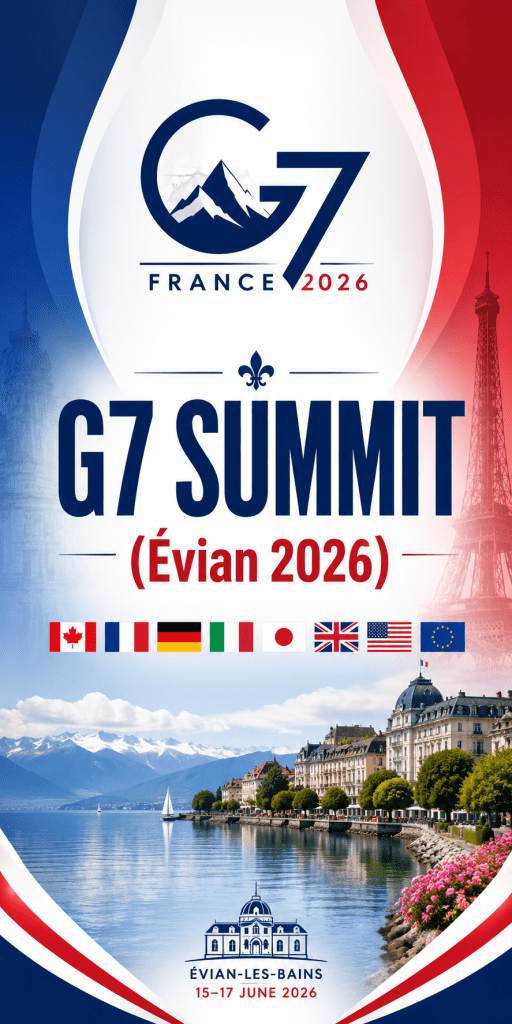
Twenty-three years after hosting the 2003 G8 Summit, the lakeside French resort of Évian-les-Bains once again became the center of world diplomacy when leaders of the Group of Seven gathered for the 52nd G7 Summit from 15th—17th June 2026. Under the presidency of France and the stewardship of President Emmanuel Macron, the summit unfolded at a moment marked by geopolitical instability, economic fragmentation, technological disruption, and renewed debates over the future of globalization.
Far more than a ceremonial meeting of wealthy democracies, the 2026 summit emerged as a forum seeking to redefine the relationship between economic openness, digital transformation and international cooperation. In an era characterized by strategic competition, rising protectionism and concerns about the sustainability of globalization, the gathering attempted to revive the G7’s traditional role as a coordinator of global economic governance.
France’s presidency framed the summit around a central concern: the existence of profound global imbalances threatening economic stability. Paris argued that China produces excessively, the United States consumes excessively, while Europe invests insufficiently. According to French officials, these asymmetries have generated geopolitical tensions, trade disputes and vulnerabilities that undermine global prosperity.
President Emmanuel Macron sought to restore the original vocation of the G7 as a platform for dialogue among major industrial democracies. Rather than focusing exclusively on crises, France designed a broad agenda encompassing finance, development, foreign affairs, trade, digital affairs, security and energy. Artificial intelligence, quantum technologies and digital infrastructure occupied particularly prominent positions throughout the discussions.
The 52nd G7 Summit underscored the growing importance of the digital economy, international exchange and renewed globalism, with United States President Donald Trump and United Arab Emirates President Sheikh Mohamed Bin Zayed Al Nahyan emerging as influential voices advocating strategic cooperation and technological transformation.
President Donald Trump emphasized economic competitiveness, artificial intelligence and global trade resilience, while engaging leaders on issues affecting digital infrastructure, energy security and international investment. His bilateral discussions with Gulf leaders reinforced United States’ commitment to strengthening economic partnerships and maintaining an open global trading system.
President Sheikh Mohamed Bin Zayed Al Nahyan, attending as a special guest, highlighted the importance of international cooperation, innovation and responsible digital development. During meetings with President Donald Trump and other world leaders, the UAE leader stressed expanding partnerships in advanced technologies, artificial intelligence and cross-border investment, reflecting the Emirates’ growing role in shaping the future global economy. Their engagement at Évian illustrated how the United States and the United Arab Emirates are increasingly contributing to a more interconnected, technologically driven and globally integrated economic order.
Besides the G7 core members comprising of the United States, Canada, Britain, France, Germany, Italy and Japan, the European Union also participated alongside invited leaders from India, Brazil, South Korea and Kenya, reflecting the growing importance of emerging powers in shaping the global order.
Unlike previous G7 meetings dominated by financial crises or climate diplomacy, the 2026 summit placed the digital economy at the center of its strategic vision. France made digital transformation primarily one of the seven principal negotiation tracks. Artificial intelligence, digital governance, cybersecurity, online safety and quantum technologies occupied significant portions of the leaders’ discussions. Experts viewed this emphasis as recognition that economic power in the twenty-first century increasingly depends on technological leadership rather than traditional industrial capacity alone.
Leading executives from OpenAI, Anthropic, Google and Mistral AI joined discussions with heads of government. Among those participating were OpenAI chief executive Sam Altman and Anthropic CEO Dario Amodei. Their presence underscored the growing influence of technology firms in shaping public policy and highlighted how AI governance has become inseparable from international diplomacy.
French authorities emphasized that AI presented both enormous opportunities and significant risks. Discussions centered on responsible innovation, data ownership, child protection online, digital infrastructure and safeguards against deepfakes and cyber manipulation. While digital taxation remained absent from the official agenda, regulatory coordination occupied a prominent place. The summit reflected a broader recognition that digital competition increasingly defines economic sovereignty. Governments are now competing not merely over manufacturing and trade but also over algorithms, semiconductor supply chains, cloud infrastructure and data governance.
France has sought to position itself as a major AI power, and the summit represented an opportunity to build common approaches among advanced economies. Discussions examined how generative AI technologies are transforming economies, labor markets and security structures. Experts warned that the rapid expansion of AI systems requires new international frameworks capable of balancing innovation with accountability. Analysts argued that competition in these sectors may determine future economic and military balances. Consequently, technological leadership increasingly overlaps with strategic security. Participants discussed digital infrastructure resilience and cybersecurity amid growing fears of sabotage and cyberattacks. The summit itself took place under unprecedented security arrangements involving cyber specialists, intelligence personnel and anti-terror units. Approximately 16,000 security personnel were deployed around Évian and neighboring areas. These extensive measures reflected growing awareness that cyber warfare and hybrid threats have become integral components of geopolitical rivalry.
French officials repeatedly highlighted the need to address global macroeconomic distortions. The expansion of Chinese manufacturing capacity, rising trade surpluses and growing industrial subsidies have generated increasing concern among Western economies. Although China was absent from the summit table, discussions focused heavily on the implications of Chinese industrial policies. France attempted to promote a cooperative approach before the European Union adopts tougher trade measures against Beijing. While no dramatic breakthroughs were anticipated, Paris considered recognition of the problem itself a diplomatic success.
The summit also examined critical minerals, strategic supply chains and economic resilience. These issues have become central to international exchange because the transition toward digital economies requires secure access to lithium, rare earth elements and semiconductors. Increasingly, globalization is no longer viewed merely as unrestricted trade but as a system requiring safeguards against excessive dependency. The discussions reflected a shift toward what economists describe as “resilient globalization”, a model balancing openness with strategic autonomy.
The G7 was born during the economic crises of the 1970s when Western powers sought coordinated solutions to common challenges. Fifty years later, however, globalization faces skepticism from multiple directions. Rising nationalism, protectionism and geopolitical rivalries have weakened faith in multilateral institutions. Against this backdrop, President Emmanuel Macron portrayed the summit as a defense of international cooperation. He emphasized that fragmentation of the global order threatens economic prosperity and geopolitical stability. The challenge confronting the G7, therefore, was not merely technical but philosophical: whether advanced democracies could still provide collective leadership in an increasingly multipolar world. Yet critics argue that the G7 itself represents a diminishing share of global economic power. Emerging economies wield growing influence, while institutions such as the G20 and BRICS have expanded their relevance. The inclusion of India, Brazil, Kenya and South Korea reflected recognition that future global governance cannot remain confined to traditional Western alliances.
Although economic themes dominated the French agenda, geopolitical crises inevitably shaped proceedings. Support for Ukraine remained central. President Volodymyr Zelenskyy’s participation highlighted continuing concerns about the prolonged conflict with Russia and efforts to maintain Western unity. European leaders sought to ensure that any future peace initiatives would include strong European participation. The situation surrounding Iran represented another urgent issue. Following developments involving United States–Iran relations and concerns over maritime security, leaders discussed reopening the Strait of Hormuz and ensuring energy market stability. Joint diplomatic efforts sought to prevent escalation and reinforce non-proliferation commitments. The prominence of these crises illustrated how economics and geopolitics have become inseparable. Energy prices, trade routes and financial markets are increasingly influenced by security developments.
Many emerging economies face severe debt pressures exacerbated by rising interest rates, climate vulnerabilities and slowing growth. G7 leaders reaffirmed their commitment to addressing these challenges, although concrete mechanisms remained unclear. France sought to advance reforms of the international financial architecture and promote the “Pact for Prosperity, People and Planet”. Development financing and partnerships with Africa featured prominently throughout the French presidency. The participation of Kenya underscored France’s efforts to strengthen engagement with African nations. The summit recognized that future global stability depends partly on narrowing inequalities between developed and developing economies. Globalism, according to this perspective, cannot survive if large regions remain excluded from economic opportunity.
Authorities implemented extensive protective measures modeled after the Paris Olympics. Restricted zones, digital access systems and border controls transformed the Lake Geneva region into a heavily monitored area. Swiss authorities also coordinated with France to reinforce security near the border. Officials cited risks ranging from terrorism and sabotage to cyberattacks and civil unrest. Anti-G7 demonstrations were anticipated in Geneva and surrounding areas, with concerns about extremist groups and violent protesters. The extraordinary security arrangements illustrated a paradox of contemporary globalization: while leaders advocate openness and international cooperation, rising insecurity increasingly necessitates physical and digital barriers.
For President Emmanuel Macron, the Évian summit represented more than a diplomatic event. It constituted an opportunity to shape his international legacy. Having attended ten G7 summits, President Emmanuel Macron sought to position France as a mediator between great powers and a defender of multilateralism. Domestic political difficulties have reduced his influence at home, but international diplomacy has remained one of his strongest assets. His efforts focused on maintaining Western unity while promoting a broader coalition of middle powers. AI governance, digital regulation and economic reform became instruments through which France aimed to exert global influence beyond its economic size. Observers viewed the summit as President Emmanuel Macron’s attempt to preserve a rules-based international order amid increasing fragmentation.
The 52nd G7 Summit in Évian demonstrated that the world economy is entering a new era. Digital technologies, artificial intelligence and cybersecurity are redefining the meaning of economic power. Traditional globalization, characterized by unrestricted trade and interconnected supply chains, is giving way to a more strategic form emphasizing resilience, technological sovereignty and selective partnerships. International exchange remains essential, but its foundations are evolving. Nations increasingly seek balance between openness and security, efficiency and resilience, innovation and regulation.
The summit also revealed the limitations confronting multilateral institutions. The G7 continues to exercise influence, yet its effectiveness depends increasingly upon cooperation with emerging powers and broader international frameworks. Ultimately, the gathering in Évian served as a reminder that globalization has not ended. Instead, it is being reinvented. As the twenty-first century advances, the contest will not simply concern who produces more goods or controls more resources. It will revolve around who shapes digital standards, governs artificial intelligence, secures technological ecosystems and preserves international cooperation in an age of fragmentation. In that sense, the 52nd G7 Summit was not merely about economics or diplomacy. It was about defining the architecture of the next phase of globalization itself; a global order where digital economy, international exchange and interconnectedness remain indispensable, even as nations navigate unprecedented technological and geopolitical transformations.
 MAGNIFICENZA